



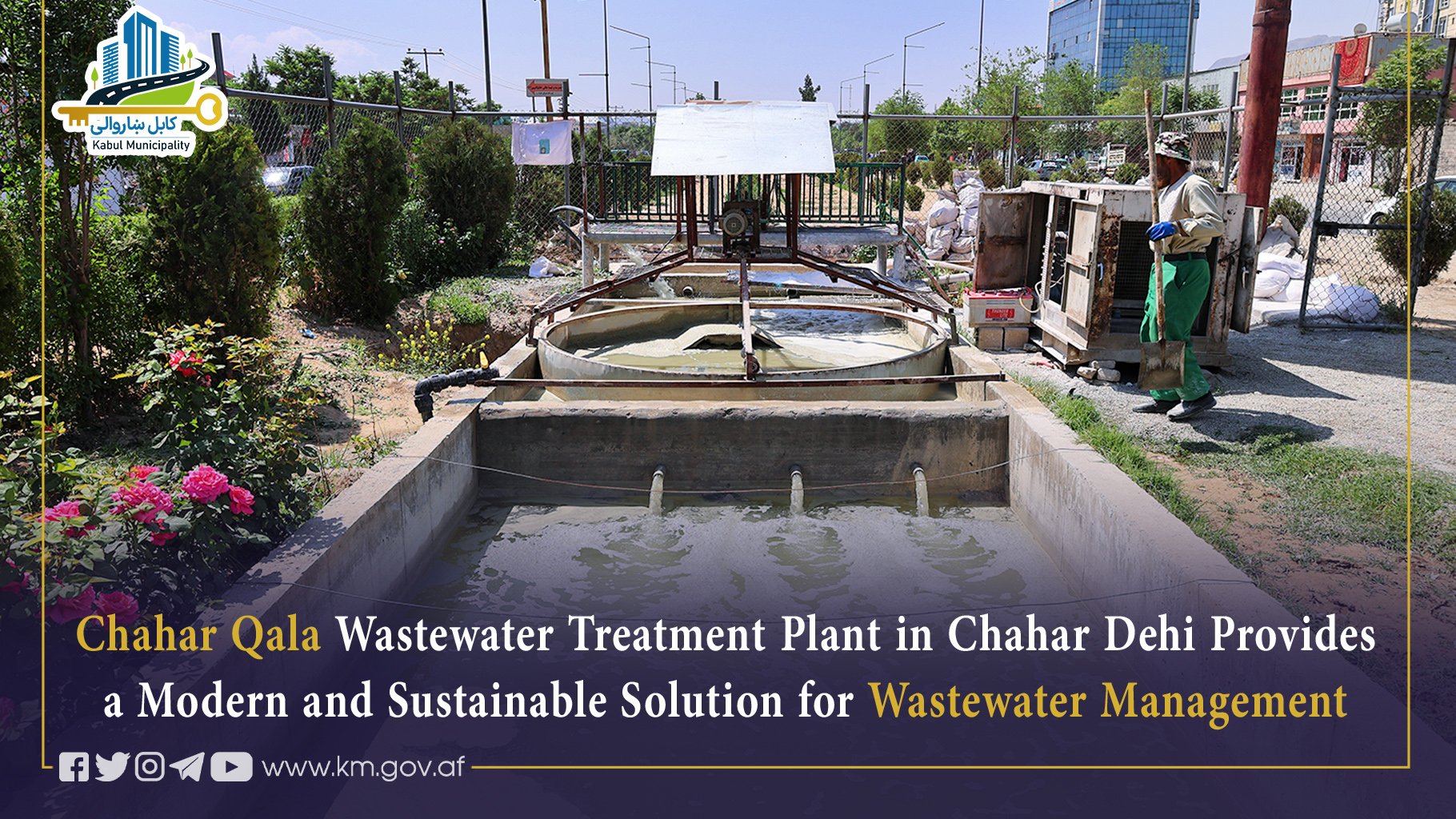
Kabul Municipality has established a wastewater treatment plant in the Chahar Qala area of Chahar Dehi as part of efforts to reduce administrative costs and prevent the unnecessary use of underground freshwater resources. The facility has been constructed to supply water for irrigating the central green areas along the road extending from Pul-e Sukhta to Darulaman.
According to available information, the Chahar Qala treatment plant is a modern system developed using AWT technology and designed through a multi-stage process. The system is capable of automated operation and is currently functioning in a semi-automated manner. Initial findings indicate that it has a high capacity for treating wastewater.
Through its advanced design, AWT technology enables water flow levels to be adjusted according to demand, while its rapid treatment capability makes it suitable for implementation on different scales, particularly in urban areas where space is limited.
Studies indicate that irrigating green areas through water tankers results in considerably higher costs due to fuel, transportation, and labor expenses compared to the use of treated water. Likewise, although drilling water wells may involve comparable costs, it is regarded as a limited and temporary solution, whereas the construction of treatment plants provides a long-term and sustainable alternative.
In addition to reducing costs, the system plays an important role in environmental protection by preventing underground water contamination, improving public health conditions, and ensuring a sustainable water supply for irrigating green areas.
It is also noted that the treatment plant has the capacity to process between 80 and 100 cubic meters of water daily, with the treated water being used for irrigating nearby green areas and flowerbeds.
Chahar Qala Wastewater Treatment Plant in Chahar Dehi Provides a Modern and Sustainable Solution for Wastewater Management